Mississippi: Outcomes Over Activity
How Mississippi moved beyond “any job is a good job” to focus on mobility and accountability.
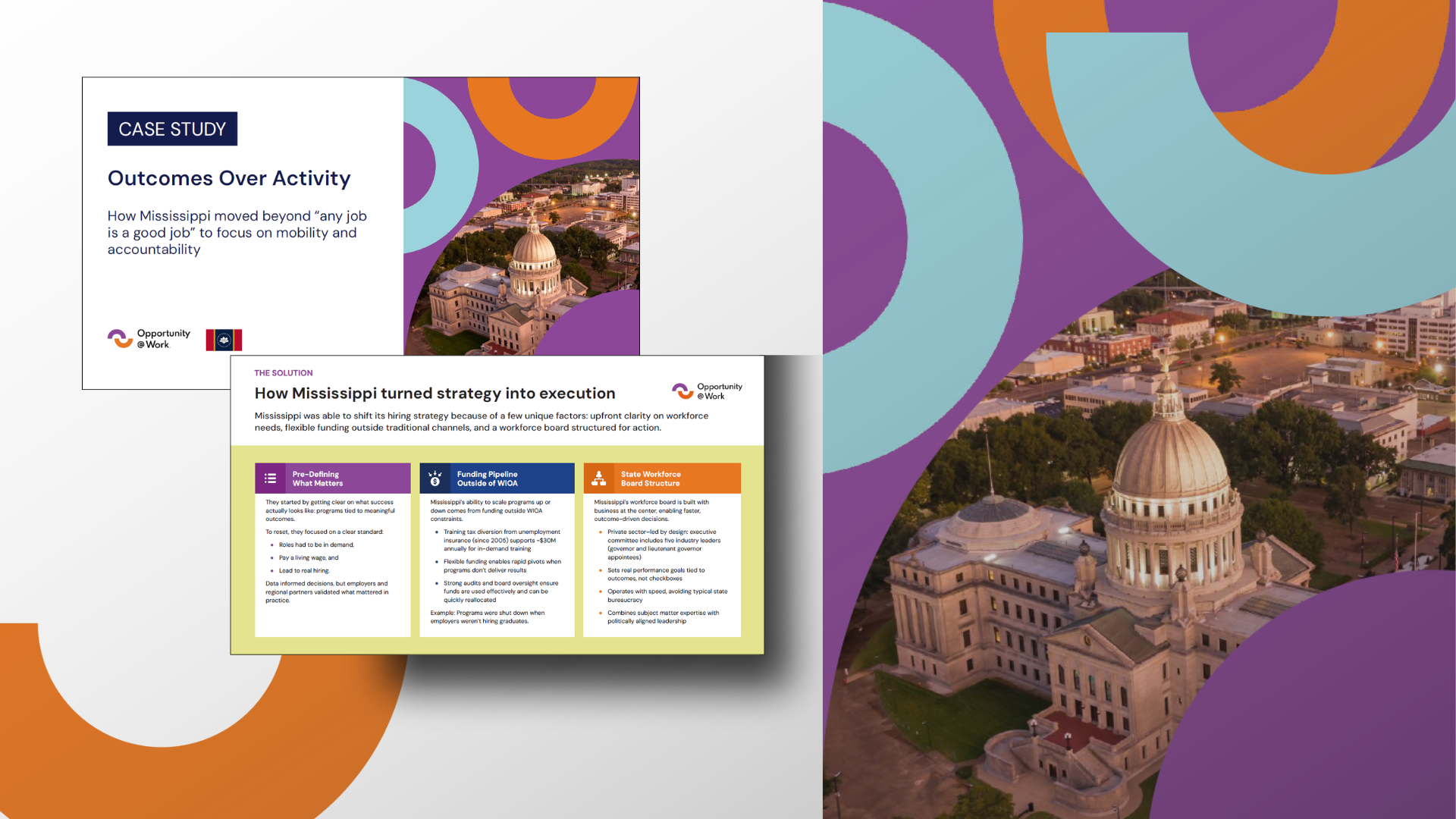
The challenge
Workforce programs measure activity: enrollment numbers. Mississippi measured outcomes. What they found: training for jobs without advancement, employer needs unfilled, a system producing activity but not mobility.
The shift
Mississippi rebuilt how it funds training. Three filters for every program:
- Is the job in demand?
- Does it pay a living wage ($20/hr minimum)?
- Will employers actually hire graduates?
If the answer to any is no, the state doesn't fund it.
The results
- Down from 90,000 to 6,000 people trained annually (deeper training for roles that matter)
- $30M redirected to in-demand, living-wage occupations
- Programs that don't produce hiring outcomes get defunded
What you'll learn
- How to identify which training programs actually work
- Why employer accountability changes everything
- The funding mechanisms that enable rapid pivots
- How to remove barriers to completion
- New models for scaling training capacity
Ready to shift your approach?
This case study shows how one state moved from funding activity to funding outcomes. If you lead workforce strategy or hiring, you'll see a model you can adapt immediately.