Don't Replace One Paper Ceiling With Another
How states can invest in credentials without losing sight of skills
Short-term credentials are a growing part of workforce policy, and programs like Workforce Pell are expanding access to them. When credentials become the required proof of skills instead of one way to show them, they can reinforce the paper ceiling for the more than 75 million workers in the U.S. who are Skilled Through Alternative Routes (STARs).
Don't Replace One Paper Ceiling With Another is a new brief from Opportunity@Work. It examines three common myths about credentials to show where they add value, where they fall short, and what that means for public sector workforce strategy.

Inside the Brief
This brief combines Opportunity@Work analysis of Lightcast worker profiles with recent research findings from Brookings, Anthropic, and McKinsey. It helps public sector leaders keep skills at the center of hiring, training, and advancement.
Myth 1:
Workers need a new credential to move into a new job.
Most workers leverage skills from previous roles to land a new job. For those moving into three IT roles, more than 52% did not have a recent degree or credential before making the transition.
Myth 2:
If more workers had credentials, more workers would be earning higher wages.
Not all credentials are valuable for workers, but they can be when they prepare workers with the skills employers need. Job-relevant credentials like CompTIA A+ can build, validate, and signal skills. However, when a credential becomes a requirement for workers who already have the skills, it turns into a barrier.
Myth 3:
A valuable credential automatically creates economic mobility.
Even valuable credentials do not generate uniform economic mobility. Two years after earning the same CompTIA A+ credential, STARs still earn over $9,000 less per year than workers with at least a bachelor’s degree.
Most workers leverage skills from previous roles to land a new job. For those moving into three IT roles, more than 52% did not have a recent degree or credential before making the transition.
Not all credentials are valuable for workers, but they can be when they prepare workers with the skills employers need. Job-relevant credentials like CompTIA A+ can build, validate, and signal skills. However, when a credential becomes a requirement for workers who already have the skills, it turns into a barrier.
Even valuable credentials do not generate uniform economic mobility. Two years after earning the same CompTIA A+ credential, STARs still earn over $9,000 less per year than workers with at least a bachelor’s degree.
"Credentials should help make skills visible, not become another barrier to opportunity. Too often, we ask workers to spend time and money re-proving skills they already have. If public sector leaders want to reach 100% of the talent pool, they need to recognize skills wherever they were built and reward them throughout a worker's career."
Justin Heck
Senior Director of Research & Data Production
Opportunity@Work

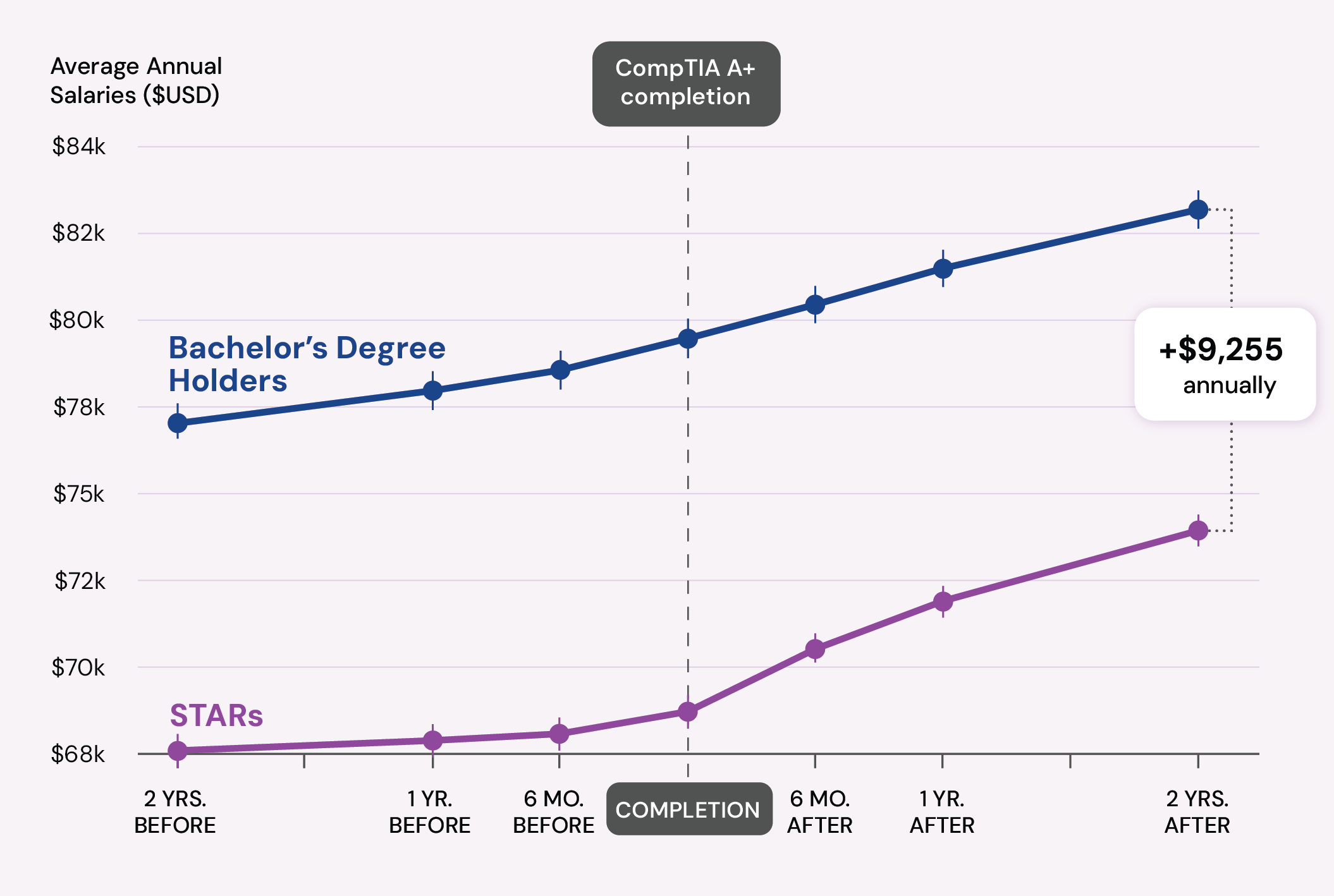
Source notes: Opportunity@Work analysis of Lightcast worker profiles, for workers with at least one job listed on or after 2015. Credential earners were identified as workers who listed the relevant credential with an end date on or after January 1, 2021. Salaries are not individual wages, and instead were collected from Lightcast job postings from 2021 to 2026 and matched by occupation, employer, and state at each checkpoint. Error bars reflect the 95% confidence interval. See the technical appendix for more information.
Make credentials a pathway, not a barrier.
Download Don't Replace One Paper Ceiling With Another
Get the data, research, and practical steps public sector leaders need to recognize and reward skills, wherever they were built.